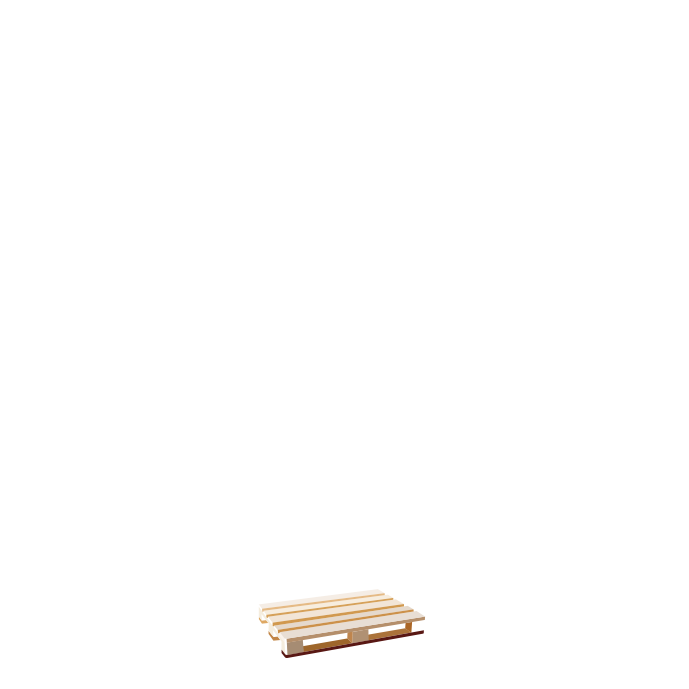
Pallets remain one of the most dependable and cost-efficient ways to move goods through every stage of the supply chain. Their construction ensures stable stacking, simple handling, and smooth transfer between transport and storage.
Timber pallets are lightweight yet strong, with slatted designs that promote airflow and allow for multiple forklift or pallet jack entry points. This combination of durability, practicality, and adaptability makes them an ideal choice for warehousing and distribution needs.

These pallets have different top and bottom decks, making them unsuitable for turning over.
Use: Commonly used for one-way shipping or where load stability is more important than reversibility.
The top and bottom decks are identical, allowing the pallet to be used on either side for extended service life.
Use: Ideal for applications where the pallet is frequently reused and flipped to extend its working lifespan.
Built with only one deck surface, these pallets — also called skids — cannot be inverted.
Use: Suited for light or specialised loads where the bottom surface does not need to support goods
The top and bottom decks are different, and the horizontal runners extend beyond the supporting blocks to form a wing, providing added strength and stability.
Use: Often chosen for larger or heavier loads where extra edge support helps prevent damage.
Identical top and bottom decks allow use on either side. The horizontal runners extend past the supporting blocks to form a wing, adding extra strength and load support.
Use: Best for heavy-duty, high-rotation use where both sides of the pallet are needed and additional strength is required.
The top and bottom decks are different, so the pallet cannot be turned over for use. Forklifts can access the pallet from all four sides.
Use: Suitable for warehouses with tight spaces where four-way forklift entry improves handling efficiency.
Identical top and bottom decks make it possible to use either side, with forklift access from all four sides.
Use: Commonly used in high-traffic storage and shipping where flexibility in loading and unloading is key.
A flat top supported by runners positioned around the perimeter of the base. The pallet is not reversible.
Use: Often used for racking applications or when extra edge support is needed for heavy or uneven loads.
Features three perpendicular runners for support. Designed to handle larger loads but not intended for flipping.
Use: Ideal for cost-conscious operations needing strong, functional pallets without premium features.
Heavy-duty design with bottom runners and a reinforced top to provide maximum support for goods. Not reversible.
Use: Best suited for heavy, dense, or high-value goods where maximum strength is required.
A flat board without forklift or pallet jack entry points, often used as a base layer or support platform.
Use: Commonly placed under goods to provide a clean, stable surface or to protect items from direct contact with the floor.